


Inside Mantis Hiddn in Addo: A Disciplined Model for Wilderness Lodge Development
Updated: Aug 28
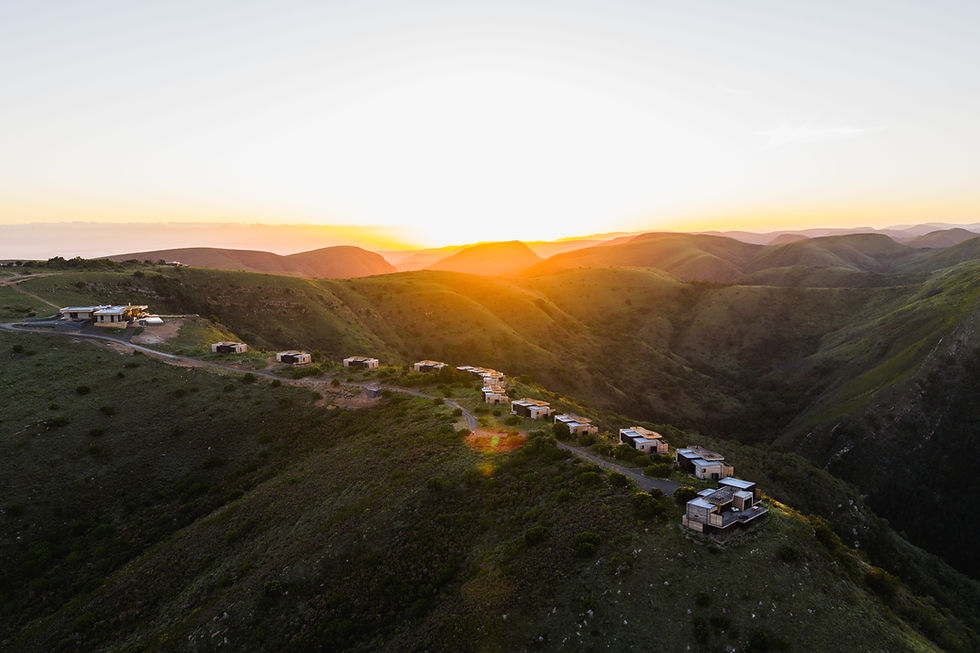
Most stories about new wilderness lodges lead with the architecture — the materials, the silhouette, the view from suite five. Those stories miss the part that actually determines whether a lodge holds its value over twenty years.
Mantis Hiddn in Addo welcomed its first guests in March 2026. Twelve suites. Two private cliff-edge villas. Fully off-grid, set on a carefully chosen mountain plateau above the Witrivier gorge inside Addo Elephant National Park. Behind the finished lodge sits a development model we believe should be the standard for remote-wilderness hospitality, not the exception.
This is how we built it — and why we lead with infrastructure logic, not aesthetics.
The thesis: discipline beats vision
Wilderness development punishes optimism. Every assumption about access, water, energy, and ecological resilience gets tested by the terrain itself. The projects that endure are the ones where land intelligence and infrastructure logic shape the early decisions, and architecture follows.
That sequence matters. When architecture leads, the result is usually a beautiful lodge with a fragile operating model: trucked-in water, generator-dependent power, costly retrofits as systems age. When infrastructure leads, the building sits more lightly on the landscape and the asset holds its margins through the decades that follow.
At Hiddn, that ordering wasn't an afterthought. It was the project.

Strategic site positioning
Mantis Hiddn occupies a mountain plateau within Addo Elephant National Park — one of the few places in southern Africa where the Big Seven (the Big Five plus southern right whale and great white shark, given Addo's proximity to the Indian Ocean) are present in a single conservation system. Site selection inside this kind of landscape is a long, quiet process. Ecological feasibility and contour-led placement shaped where each structure could go before a single line of architecture was drawn.
The result is a lodge that reads as embedded in the terrain rather than imposed on it. That restraint is also a commercial decision: low-impact siting protects the long-term value of the surrounding land, which is the asset behind the asset.
Planning and logistics: 18,000 loads, zero incidents
The plateau sits at roughly 700 metres above sea level, accessible by a single mountain track. Every component of the lodge — structural, mechanical, finish — had to be moved up that track without compromising the road, the surrounding bush, or the project schedule.
Over the build, more than 18,000 loads were delivered to site. Not one resulted in a recordable incident. That outcome doesn't happen by accident. It is the product of vehicle selection matched to the terrain, sequencing that protected the access route from cumulative damage, and planning that treated logistics as a first-class design constraint rather than a contractor problem.
In remote builds, logistics is where projects quietly bleed time and money. Treating it as a strategic discipline up front is what kept Hiddn on programme.

Low-density asset design
Twelve suites and two private villas. That footprint was deliberate.
The temptation in hospitality development is to scale — more keys, lower per-key cost, faster payback. In a wilderness asset, scale erodes the very thing guests are paying for: solitude, ecological intactness, the sense that the landscape extends uninterrupted in every direction. Hiddn was never conceived as a scale-driven project. The footprint was set by ecological sensitivity and contour-led placement, then validated against the operating model — not the other way around.
The cliff-edge villas exist for a similar reason. They give the asset a defensible top-tier product without adding density elsewhere on the plateau.
Off-grid infrastructure: the part nobody photographs
The real story sits beneath the architecture.
Hiddn runs on independent energy, water, and waste systems. Solar generation paired with advanced battery storage carries the operational load. Long-term water modelling underpins a resilient supply that does not depend on imported logistics. Waste is handled on site.
This is the infrastructure layer that determines whether a wilderness lodge is genuinely operable or merely marketable as such. It also determines unit economics: every system that reduces dependence on trucked inputs improves margins and resilience for the lifetime of the asset.
Strategic leadership
Bruce McNicol led the project end-to-end — land scouting and feasibility, master planning, sustainability integration, guest experience design. The point is not the title; it is the continuity. When the same person carries the project from terrain assessment through commissioning, early decisions and late decisions stay aligned. Architectural intent, infrastructure logic, and operational realities are resolved together, not handed off and re-litigated at each stage gate.
"True value in wilderness development comes from discipline. At Hiddn, land intelligence and infrastructure logic informed every early decision, guiding the architectural collaboration so that design, terrain and long-term performance worked as one." — Bruce McNicol, Terra Nova Create

What Hiddn proves
Mantis Hiddn in Addo is one completed lodge. But for us, it is also a working argument for a particular way of developing in wilderness: vision and viability treated as equal priorities, infrastructure leading architecture, and discipline applied at every stage where the temptation is to defer it.
Conservation-aligned hospitality only works as a category if the assets behind it perform — operationally, financially, and ecologically — for decades. That outcome is built in the early decisions, long before the first guest arrives.
If you are exploring a wilderness or conservation-led development, this is the model we apply.
Terra Nova Create develops conservation-aligned hospitality assets in remote wilderness environments, with an integrated focus on land intelligence, infrastructure logic, and long-term operational performance. terranovacreate.com


Comments